
- Home
- Products
- About
- DIY
- Support
- Blog
- Contact
- EN/CN
-
- OEM vs ODM: A Guide for Smart Furniture BrandsPublished:2026-10-26 Views:58




When developing standing desks, brands have two options. They can use their own designs or choose existing designs from a manufacturer.
These are the two main approaches: OEM and ODM.
Choosing OEM or ODM affects costs and delivery times. It also affects how easily a brand can develop new products and grow its business.
Brands should choose a manufacturer that understands the technology, makes reliable products, and can produce its own components. Factories in different countries can also be an advantage.
1. OEM vs ODM: What's the Difference?
OEM stands for Original Equipment Manufacturer, while ODM stands for Original Design Manufacturer. With OEM, the brand provides its own product design and specifications, while the manufacturer handles production. With ODM, the manufacturer offers existing product designs and technology, which the brand can customize to meet its needs.
· OEM (Original Equipment Manufacturer): Manufacturing based on the customer's design, technical specifications, or product requirements.
· ODM (Original Design Manufacturer): Manufacturing based on existing product designs or technology platforms, with customization available within an agreed scope.
In practice, market demand often blurs the distinction between OEM and ODM. Smart furniture brands can bring their unique designs and integrate them into a manufacturer's proven drive system. As a result, they save on development costs without losing their market edge.
Comparison Dimension OEM Model ODM Model Product Design Generally based on designs or technical specifications provided by the brand owner Generally based on existing designs or product platforms of the manufacturer Development Division of Labor Brand owner leads product definition; manufacturer provides engineering and production support Manufacturer provides existing designs and product development support Customization Scope Can be deeply customized based on project requirements, depending on technical feasibility Typically revolves around existing product platforms and agreed-upon modification scopes Initial Investment New designs, mold development, and testing may increase investment Can reduce some repetitive development work if existing platforms meet requirements Time to Market Depends on design complexity, testing, and production preparation Can shorten the development cycle if existing solutions are mature and meet requirements Product Differentiation More suitable for products with clear design and technical requirements More suitable for product expansion based on mature platforms Applicable Scenarios Brands that need to customize product structure, performance, or functions Brands that wish to expand product lines using mature product solutions 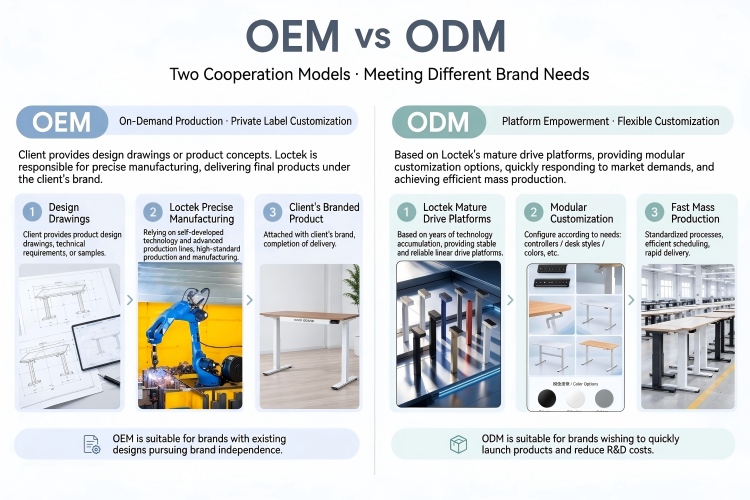
2. Why Technical Collaboration and In-House Capabilities Matter in Smart Furniture Manufacturing
Smart furniture is inherently different from conventional furniture. It involves more than assembling panels and metal frames. Mechanical structures, linear motion systems, electronic controls, and safety functions must work together as an integrated system.
For an electric standing desk, performance and longevity depend on more than just the frame. They rely on how effectively the lifting columns, motors, and control boxes function as a unified linear drive system.
Developing a custom product requires a manufacturer who understands these component interactions and can rigorously evaluate designs and manufacturing specifications for mass production.
2.1 Moving Beyond Product Assembly to Integrated Drive-System Engineering
Core performance metrics in electric standing desks are deeply co-dependent. Consequently, reaching a performance target takes more than just sourcing individual parts that meet standalone specifications.
Manufacturers can add value by participating in Design for Manufacturability (DFM) reviews early in the development process. This helps identify potential structural, process, and component-integration issues before they become more costly to address.
Early engineering collaboration can reduce design revisions, clarify prototype validation requirements, and establish more consistent technical standards before mass production begins.
2.2 How In-House Component Capabilities Support Product Development
· For OEM projects, in-house core component capabilities help manufacturers precisely interpret technical specifications and execute seamless engineering collaboration.
· For ODM buyers, this technical foundation ensures a faster, more accurate evaluation of standard platforms and custom configuration flexibility.
Relying heavily on third-party suppliers often complicates spec adjustments, system integration, and technical troubleshooting by forcing brands to coordinate across multiple vendors. Conversely, a manufacturer with integrated R&D and component production can directly engage in component selection, system matching, and issue resolution.
Naturally, in-house manufacturing does not mean unlimited customization for every project. The chosen product platform, technical specifications, and project scope ultimately dictate the available customization options.
3. When Should You Choose OEM?
OEM is ideal for brands with clear designs, defined specifications, or distinct differentiation goals.
Here, you define every detail—from lifting ranges and load capacities to frame designs and control interfaces.
Key evaluation pillars for an OEM partner:
· Engineering Collaboration: The partner’s ability to interpret complex product designs and evaluate structural and technical viability .
· Core Component Capability: Whether key components meet the performance, reliability, and spec requirements of the project.
· Product Validation: The availability of testing and quality assurance protocols aligned with project standards.
· Mass Production Management: The capacity to consistently maintain agreed-upon specifications throughout high-volume manufacturing.
· IP Protection & Clarity: Clear contractual boundaries regarding the ownership of designs, technical data, and development outcomes.
In short, OEM is ideal for brands with clear designs, strong product control, and dedicated engineering resources. Choosing a partner with reliable technical support and quality control ensures your designs turn into successful products.
4. When Is ODM a Better Fit?
ODM is ideal for brands looking to expand their product portfolios or enter new market segments. It allows them to shorten development timelines without building a custom product from scratch.
With ODM, the manufacturer supplies a core technology platform or existing design. The brand can choose a solution that fits its market and tailor the styling, specs, or features within an agreed framework.
Take a brand entering the standing desk market:
· First it can test a standard frame to see if its load capacity, travel range, and specs meet its requirements.
· Then, it can customize the desktop, control box, and additional features based on its brand positioning.
When a standard platform meets most technical specs, brands don't need to redesign the entire product. They can simply focus on product positioning, market entry, and sales expansion.
5.What Should You Evaluate When Choosing an ODM Manufacturer?
The ODM model builds on a manufacturer's proven product designs, technical platforms, or ready-to-market solutions. Brands simply pick an existing product platform and customize its look and features within allowed limits.
For example, a new desk brand can start with a ready-made frame that has the right lifting height and weight capacity. Then, they simply choose the right desktop, control panel, and accessories to match their brand.
By using a proven platform, brands don't need to re-engineer everything from scratch. Instead, they can focus their resources on marketing, sales, and market growth
Key Evaluation Factors for ODM Partners:
· Platform Compliance: Does the existing product meet target market technical standards and certifications?
· Performance Verification: Can the supplier provide empirical testing data and performance validation?
· IP Clarity: How are rights assigned for product designs, customized iterations, and tooling?
· Supply Chain Continuity: Can long-term supply stability and quality management support your growth?
5. How AOKE Supports OEM&ODM Partnerships for Smart Furniture Brands
For smart furniture brands, choosing a manufacturing partner means finding more than a supplier. It means working with a company that can support product development, engineering coordination, quality management, and long-term supply.
AOKE specializes in linear motion technology and smart workspace solutions. AOKE supplies electric standing desks, desk frames, lifting columns, and linear motion products to B2B customers worldwide. We support both OEM and ODM partnerships tailored to specific project needs.
5.1 More Than 14 Years of Linear Motion Technology Experience
AOKE's product portfolio includes electric standing desks, desk frames, lifting columns, and linear drive systems.
Smart furniture integration demands precise coordination across mechanics, linear motion, and electronics. Our engineering team brings deep expertise in technical alignment, drive solution selection, and spec verification.
Your design or our platform—AOKE delivers the right OEM or ODM strategy for your business.
5.2 More Than 90% of Core Components Developed and Manufactured In-House
AOKE produces over 90% of its core components in-house. This allows tight integration between design and manufacturing.
For OEM projects, this capability can support technical discussions and manufacturing coordination around agreed product specifications. For ODM projects, it can help assess how existing product platforms and configurations align with the intended application.
The value of in-house capabilities extends beyond production. A deeper understanding of key components enhances technical alignment and streamlines post-launch troubleshooting. Specific development and customization options depend on the product platform and project requirements.
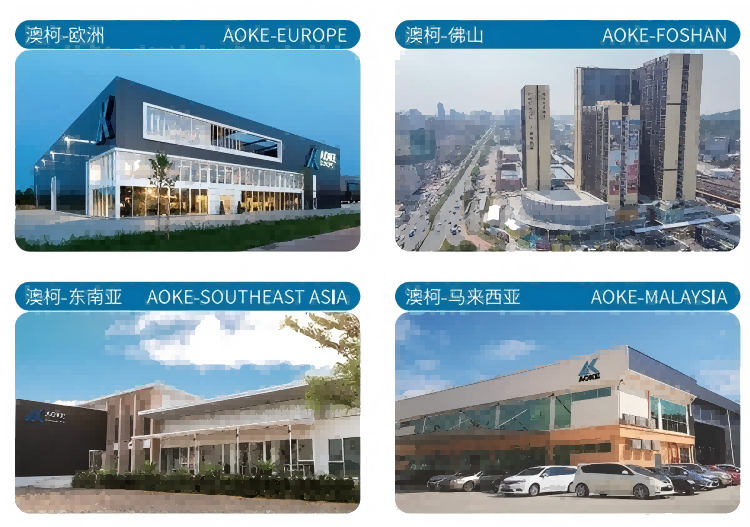
5.3 Manufacturing Facilities in China and Malaysia
AOKE operates manufacturing facilities in China and Malaysia, supporting its manufacturing operations and supply chain for global customers.
For furniture brands, manufacturers, and project partners serving different markets, this manufacturing footprint provides additional options to evaluate production planning and supply chain arrangements.
The right supply strategy depends on your product type, production capacity, target market, and delivery timeline.
5.4 Experience Serving Global B2B Markets
AOKE serves customers in more than 60 countries and regions and works with over 1,000 partners and customers.
Different markets have different application needs, product configurations, and project requirements. Experience across international markets helps inform customer discussions and the evaluation of potential cooperation models.
Clear upfront alignment ensures project success. Before starting a project, partners should agree on product specs, target markets, customization, delivery, and service.
5.5 End-to-End Quality Control for Consistent Product Delivery
Quality management in smart furniture manufacturing must extend beyond final product inspection. It should cover project evaluation, production preparation, manufacturing processes, finished-product inspection, and shipment.
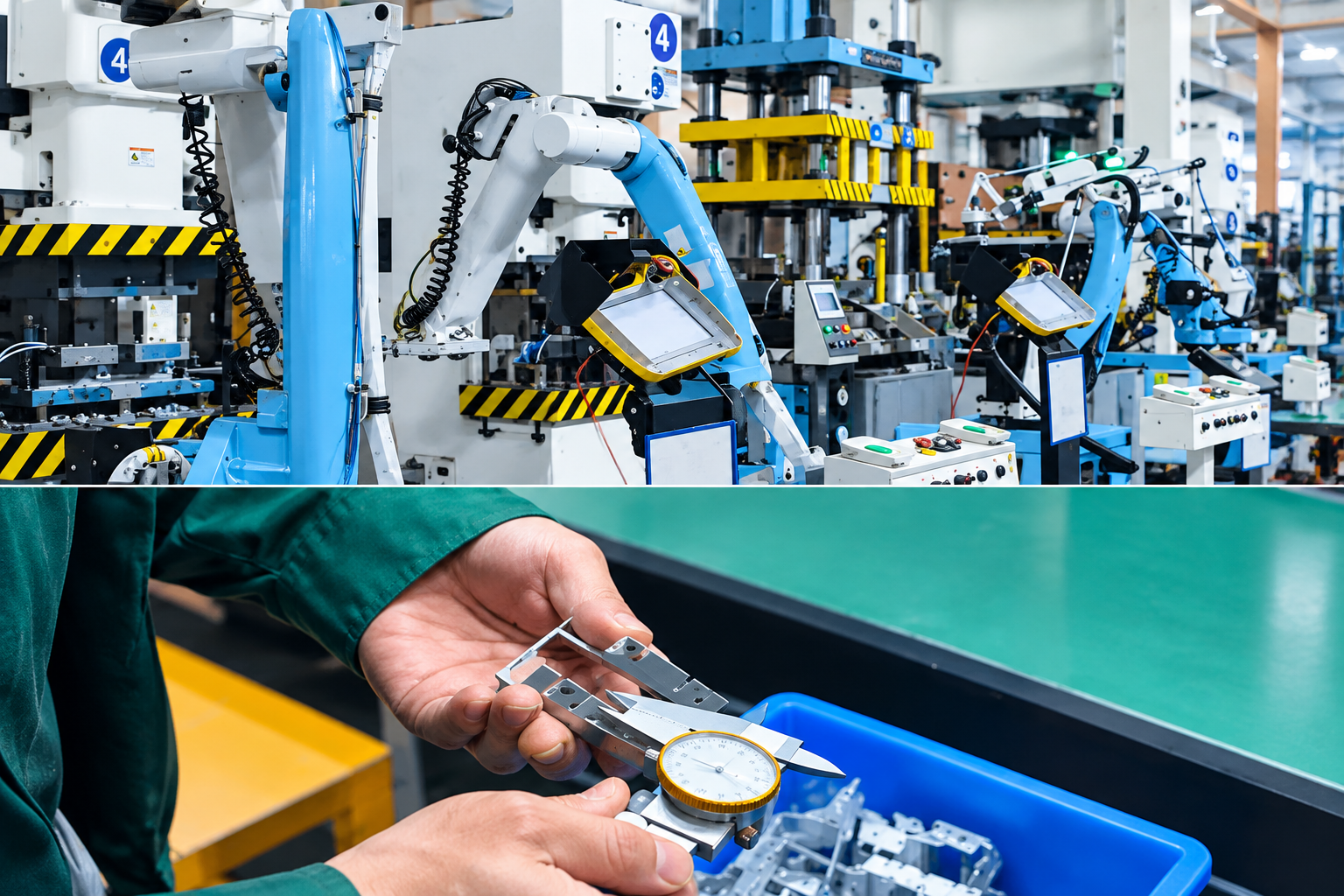
AOKE enforces end-to-end quality control, from initial RFQ risk assessment and PFMEA analysis to 100% motor performance testing, First Production Approval (FPA), and final Pre-Shipment Inspection (PSI).
Key motor performance checks include speed, current, and signal integrity. Together with process inspections and quality traceability, these controls support manufacturing consistency and continuous improvement.
For OEM and ODM customers, clearly defined product specifications, inspection requirements, and quality standards help reduce misunderstandings during development and mass production.
Learn more about AOKE's Quality Control System
6. How to Choose the Right OEM or ODM Manufacturer
Whether you choose OEM or ODM, the decision should start with your product requirements and long-term business objectives. Evaluate whether a manufacturer has the technical, production, and service capabilities needed to deliver on those requirements.
Consider these five factors:
1. Technical capabilities
2. Validated product specifications
3. Customization and intellectual property
4. Production and supply reliability
5. Long-term collaboration
7. OEM or ODM: Choosing the Right Manufacturing Path for Your Brand
OEM and ODM offer different approaches to product development and manufacturing. Neither is universally better; the right choice depends on your product strategy, engineering resources, and market objectives.
If your brand focuses on direct ownership of product architecture and custom engineering, OEM is the way to go. If your goal is speed-to-market and lower total development costs, ODM offers a practical, reliable shortcut.
Whichever model you choose, engineering collaboration, core component capabilities, quality control, and reliable supply remain important factors when evaluating a smart furniture manufacturing partner.
Combining linear motion expertise, in-house manufacturing, and dual China-Malaysia bases, AOKE delivers end-to-end quality control. We empower smart furniture brands to evaluate, develop, and scale the ideal OEM or ODM manufacturing solution.
Developing a new smart furniture product or expanding your existing product range?
Contact AOKE to discuss your product design, technical specifications, customization requirements, and production plans. Together, we can evaluate a manufacturing solution and cooperation model that aligns with your project goals.
Compare Products 0
No products for comparison
-